Today every industry is dependent on welding. From large machines to heavy structures, everything is incomplete without welding. If the weld is weak, the entire structure is at risk. Therefore, choosing the right welding technique and the right filler material is very important.
One such reliable technique is SMAW Welding. Its proven durability and consistency make it a trusted choice for heavy projects, reinforcing trust in the process.
Royal Arc designs its welding products with this combination in mind, ensuring welders get both quality and reliability.
What is SMAW Welding?
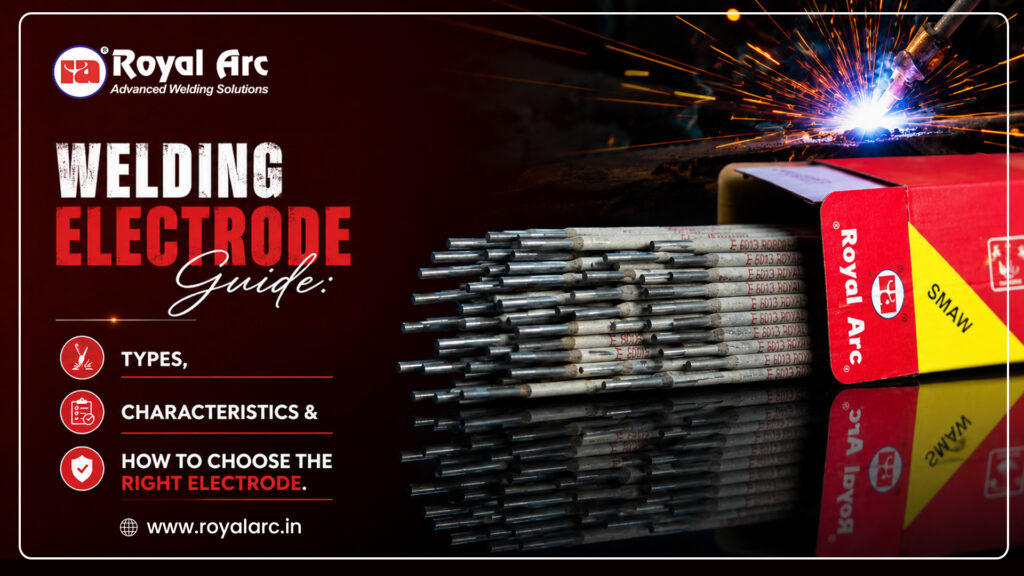
SMAW stands for Shielded Metal Arc Welding. It is also called stick welding because the electrode is stick-like. In this technique, the welder uses a flux-coated electrode. An arc is formed between the electrode and the base metal. This arc melts the metal and creates the joint.
The flux coating forms slag over the weld. This slag protects the metal from air and keeps the weld pool stable. After the weld cools, the welder removes the slag, resulting in a solid, strong, and clean joint.
The great thing about SMAW welding is that it is straightforward and accessible. You can perform it with minimal equipment-just a machine, cables, electrode holder, earth clamp, and electrodes. No complex gas systems or high-tech setups are needed, making it a reliable choice for all users.
Working Principle of SMAW Welding:
The entire process in SMAW is very simple, but technically quite impressive. The welder places the electrode in the holder and turns on the power source. When the electrode touches the base metal and then slightly removes it, an arc is formed.
This arc generates a lot of heat. This heat melts both the top portion of the base metal and the electrode tip. The molten metal that forms is the weld pool. The flux melts and forms a gas shield and slag layer over this pool. This layer protects the weld from oxygen, nitrogen, and surrounding moisture.
When the weld cools, the metal solidifies, forming a permanent joint. The welder then removes the slag with a chipping tool or wire brush. He can also throw up and pass if needed.
This simple yet effective principle makes Smaw Welding useful in all types of projects.
Advantages of SMAW Welding:
The advantages of Smaw Welding make it very practical even today.
Simple setup: This technique doesn’t require a lot of equipment.
A power source, an electrode holder, and some electrodes are all it takes.
Useful everywhere: You can perform Smaw Welding on the shop floor, site, plant, workshop, or even in remote locations. It works even in wind, light rain, dust – where other processes stop.
Versatile Materials: This allows you to work on carbon steel, low alloy steel, some stainless, cast iron, etc., with the right electrode.
Heavy Duty Joints: Thick plates, structural beams, machine frames, pipes – Smaw Welding provides excellent penetration and strength on all of them.
That is why, even though automatic and semi-automatic processes have come into existence, SMAW still remains the first choice for “field work” and “tough conditions”.
Limitations of SMAW Welding:
Every technique has limitations, including Smaw Welding. The electrode length is fixed. When one electrode runs out, the welder must insert a new electrode. This slows down continuous welding.
Slag removal is necessary after each pass. If the slag is not removed properly, the next pass will not fuse properly. Production speed may be lower than processes like MIG and SAW, especially in high-volume, repetitive jobs.
However, where conditions are difficult, budgets are limited, and field welding is required, Smaw Welding still proves to be the most practical.
What is EM12K?
This high-quality low-alloy or carbon steel filler wire offers exceptional strength and reliability, instilling confidence in demanding projects.
Now let’s talk about Em12k. Em12k is the name of a welding filler wire/grade. It is designed for welding high-quality low-alloy or carbon steel (often in SAW, and also in other process combinations depending on the project).
The uniqueness of Em12k lies in its chemical composition. Its balance of silicon and manganese provides a clean, strong, and well-finished weld metal.
Welds made with this grade have good machinability and a strong joint. When a project involves heavy loads, vibrations, or continuous stress, grades like Em12k are more reliable. This is why the industry is interested in them.
Understanding how SMAW electrodes like Em12k integrate with other welding processes ensures consistent strength throughout the project, addressing concerns about process compatibility and quality control.
Sometimes you might wonder, SMAW is stick welding, and Em12k is a wire grade. So where does the combination of Smaw Welding and Em12k fit in? In fact, it’s often the case in industry that different processes and consumables are used on different sections of a single project.
For example:
Em12k is used for SAW or automated welding on one part of a structure. On-site repairs, joint finishing, or difficult-to-reach areas are often accomplished with Smaw Welding.
When the entire project is designed with the strength level and compatibility of the Em12k grade in mind, the SMAW electrodes used in the field are fully compatible with the Em12k grade. This ensures consistent quality and performance across different project stages.
This is where the concept of Smaw Welding Em12k comes from. This means that the project uses the SMAW process, yet the grade or strength level matches that of Em12k.
Manufacturers like Royal Arc ensure that their products work in combination, not just as standalone items.
Why is SMAW Welding Em12k a Strong Combination?
When you combine Smaw Welding with Em12k, a few key points become clear. You get a process that’s flexible depending on the conditions. You also get a grade that offers high levels of strength and performance.
The advantages of this combination are as follows:
You can maintain a strength class similar to Em12k on larger projects. SMAW can be used for field welding or repairs, but the results can be kept consistent with the project’s main grade.
The welding output is technically strong and practically useful. This is why many engineering and structural projects use a combination of SMAW and Em12k, even if the process is at different stages.
Em12k is especially useful in heavy-duty applications such as structural steel, bridges, and offshore platforms, where high strength and reliability are critical for safety and durability.
Em12k grade is very useful where strength, repeatability, and reliability are essential. For example:
- Heavy structural beams and columns
- Bridge structures
- Crane girders and hoist structures
- Pressure vessels and tanks
- Heavy machine bases and frames
- Power plant structural parts
In such projects, you can’t rely on just any average grade. You need a filler that will protect the joints for years. That’s where Em12k and its compatible consumables come in handy.
Why Choose Royal Arc?
- Royal Arc has long been a trusted brand in the welding industry.
- The company manufactures high-quality products for both Em12k and Smaw Welding.
- Every product is tested, and only that is sent to the market.
- Delivery is on time, and technical support is also available.
- Royal Arc’s goal is strong welds and safe projects.
Conclusion:
Smaw welding remains a trusted technique in the welding industry today. When Em12k wire is used correctly, the joint is very strong and durable. Smaw Welding Em12k is a perfect and safe choice for heavy machinery, pipelines, structures and industrial projects. If you want long-lasting weld quality, Royal Arc products will meet your needs.